
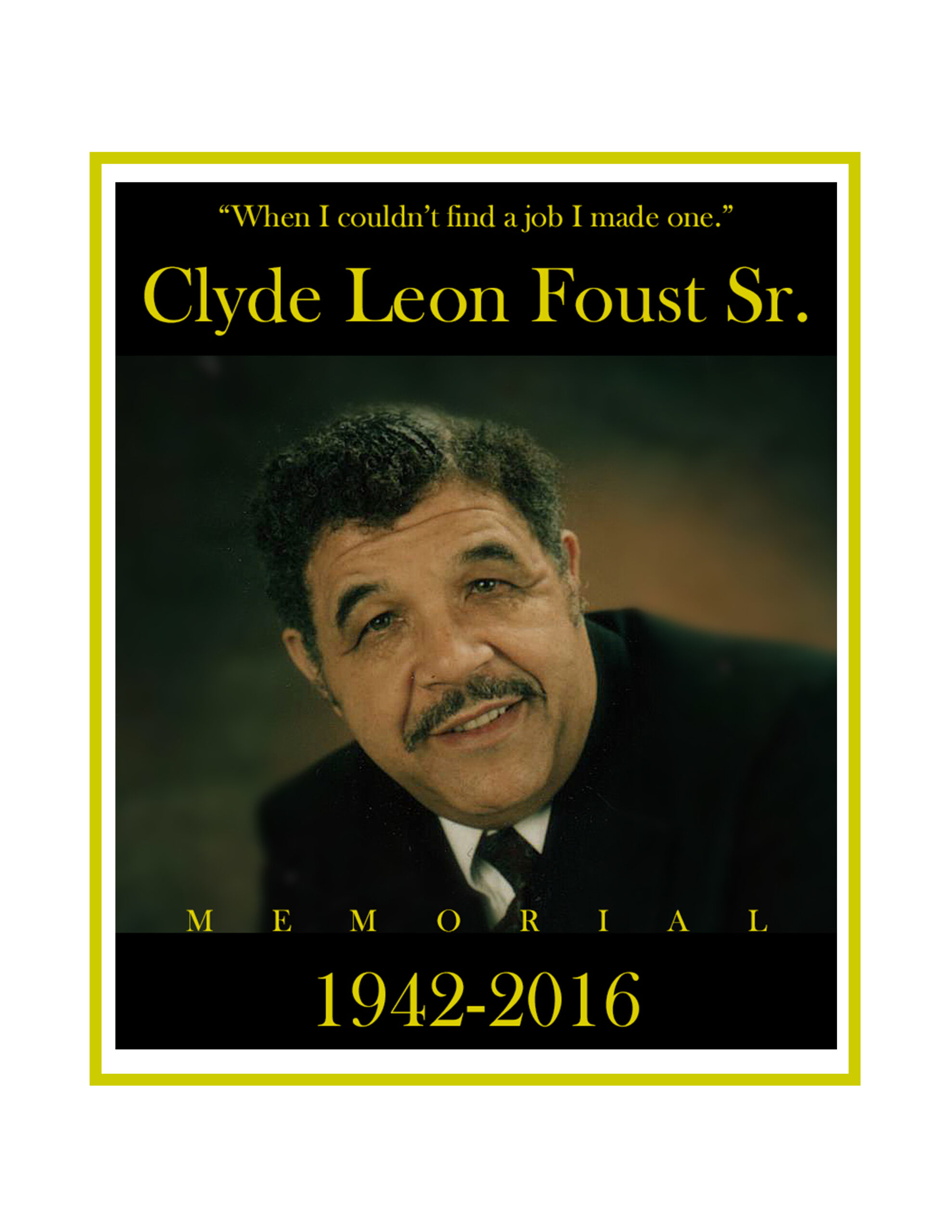
Clyde Leon Foust Sr.
Mrs. A.O. Ledwell, a midwife, delivered Clyde Leon Foust at 5:00 am on November 20, 1942. He was the last son born to 42-year-old Hijah and 31-year-old Dora Gertrude Letterlough Foust.
As a young boy on the farm, he remembers that they did not have an indoor toilet or electricity. He did his homework by light from a lamp. When they finally got electricity, there was one light bulb in the middle of the ceiling, but Clyde remembers it seemed so bright.
He started school at the age of five and was a young, bashful country boy. He felt out of place because he had to wear Brogans shoes to school, and the city children wore regular shoes. Plus, his mother would fix ham biscuits for his lunch, and his classmates had sandwiches made with loaf bread. Because he was ashamed, he would hide and eat. It was only after growing up and talking to some of his classmates that he learned they envied his ham biscuits and thought he was hiding when he ate because he didn’t want to share.
The Foust children had to get up early enough to do their chores, which included feeding two mules, two cows, chickens, several pigs and hogs, washing up, eating breakfast, and catching the school bus by seven o’clock. Family members say that early rising and being on time were problems for Clyde even then.
By his own admission, Clyde did not do well in school his first year, but he was never at the bottom of his class, even though he did not understand much of what was expected of the students. He received a whipping in first grade because he could not spell the word “and.” To this day, he thinks it was an undeserved whipping. He feels the teacher should have just taught him how to spell. Throughout his early school years, one teacher would want him to skip a grade, and another would think he was a little slow.
The Foust family raised most of what they ate, and the children were expected to help with the crop of corn, wheat, tobacco, and vegetables. Clyde, along with Scoopie, Arnold, and Melvenia, worked on the farm using a team of mules, Buck and Rhody, to haul hay and plow the 50-acre farm. They also raised chickens, ducks, and hogs.
Clyde cannot remember a time when he wasn’t ambitious. He was always trying to find a way to get ahead. When he was 12 years old, he made a bargain with Elbert Caviness that if Elbert would furnish a tractor and seed, Clyde would do all of the work. He worked the fields at night after having completed his chores on the family farm and did not miss a day of school. Two years later, he purchased a tractor and other farm equipment to raise corn, wheat, milo, and tobacco, and convinced Melvenia to help with the harvest.
Clyde became interested in photography at an early age and sold seeds to earn his first camera. Soon, he had a make-shift darkroom on the farm and started working for Marston Wright at Wright’s Studio in Asheboro.
Mr. Goldston, the school band director, started Clyde out on the trombone, and he exceeded Mr. Goldston’s expectations. Clyde nicknamed his trombone after Ginny Parson (his main crush and a classmate), and in a short period, he had worked his way up to first chair. Although Mr. Goldston could not give a student the title of assistant band director, he said Clyde was his right hand. Mr. Goldston was going through a divorce and didn’t know until the last minute that he had to be in court the day of a band competition in Greensboro. When Clyde was told he would have to take the class to Greensboro and be responsible for them, he almost fainted. However, Goldston’s confidence was not misplaced as the band came home with a high rating. After graduating, he loaned his trombone to his cousin, Mackie Lewis, who lost Clyde’s beloved “Ginny.”
When Clyde was 16, he graduated from Central High School. He and several of his buddies could not find jobs. Consequently, he decided to enlist in the Air Force. His heart was set on being in the Air Force’s marching band, but he did not qualify, and he settled for training as a mechanic. While stationed in Rantoul, IL, he, along with a White soldier, pooled their money and paid between $75 and $175 for an old 49 Chevy. It had bad brakes, and the tires were bald, but they were glad to have transportation. They agreed to alternate using the car on the weekends.
The only letter Clyde ever got from his father arrived during his assignment at Rantoul. Mr. Hijah had bills that needed to be paid to avoid foreclosure on the farm and wanted to sell Clyde’s tractor. It was his weekend to have the car, and so he put three used tires in the trunk, got together with other soldiers from North Carolina, and they raised enough money to buy gas to get home. The brakes were in such bad shape, whoever was driving coming down those treacherous West Virginia Mountains had to pump the brakes around the curves. When he arrived home safely by the grace of God, he realized he had no money and had not bought Christmas presents for his daughter, Benita, his mother, or any other family members.
He returned to Rantoul, in the ’49 Chevy that on its best days got up to 60 miles per hour, to complete a course in automatic transmissions and then was stationed in Thule, Greenland. This year was a complete culture shock for him. The total population, except for servicemen, was Eskimos; there were no paved roads or other things we take for granted in America. He made many pictures of the snow and the ice “Christmas Tree”, the soldiers created from a pole using a water hose.
His next assignment was at Peace AFB in New Hampshire. There, he was able to use his love of photography to gain employment. He mostly worked in a lab but also made pictures at the ski resorts in Vermont. While stationed at Peace, he received word of his father borrowing money from the Farmers’ Bureau that had to be repaid. He headed home, stopping in Baltimore, Maryland, to pick up Scoopie. When they arrived in Asheboro, they got together with Arnold and paid the loan.
Once he finished four years with the Air Force, Clyde realized there was no opportunity for him in the service, and he returned to Asheboro to look for work. He applied at the Chevrolet Dealership, and even though he was a trained mechanic, and it was 1964, he was told they did not need a janitor. Arnold got him a job at Boren Brick in Pleasant Garden, where he did hard manual labor loading hot bricks from the kiln.
In 1964, Clyde decided to start a photography studio. He began renting space from Mrs. Clelly Gailes at Gailes Funeral Home at 500 Greensboro Street. For $12.00 per month, he used the layout room for his studio and a small room next to the embalming room for his darkroom.
Mrs. Elizabeth Scotten Jones, a visionary and community leader, sponsored a job seminar that Clyde attended. There, he met the Birkenhammers, owners of United Brass Works in Randleman, NC. They offered him a job on the spot, but he did not want to start a job on Friday the 13th and told them he would be there bright and early Monday Morning.
During this period, he rekindled a relationship with Betty Foxx of Greensboro, whom he had met while starring in the Senior Class Play in 1960. On the second date, he teasingly told her he was going to marry her and take her to Asheboro to fatten her up. She was a city girl, but had heard her daddy talk about fattening the cow for the slaughter, so that did not go over too well. However, the next year on December 16, 1965, they were married by Bishop G.W. Rice at his home in Greensboro with his wife, Evelyn, and a neighbor, Cleo Moore, as witnesses. After exchanging their vows, Clyde asked for a special prayer. They shared their wedding dinner of pork n’ beans and franks in his three-room house at 1129½ Old Salisbury Road (now Martin Luther King Drive).
The house was really three unfinished private rooms. Clyde’s uncle, George Staley Maness (husband of Ruby Letterlough), helped him cut doors between the rooms. For a few months, they carried water about a quarter of a mile from Wright’s Store, but with the help of Charley Hatchett Wilton Amaker (Betty’s stepfather) and one of the owners of Asheboro Plumbing & Heating Company, they soon had a water pipe on top of the ground going up the driveway and into the house.
When Mrs. Gailes raised the rent to $25.00 per month, Clyde purchased the old Wright’s Store’s storage building for a studio. To increase traffic flow to his business, Clyde decided to sell records. Soon, he was spending too much time playing records, and he decided to put in a jukebox so that customers could hear the records before buying. He could not get a company to put in a jukebox, so he called Brady’s Jukebox Company in Charlotte to buy one. The only problem was that you had to be a dealer and buy at least three machines. Clyde ordered them and started looking for places to put the other two. He ended up placing all three in different locations. That was the birth of Foust Photo & Music and a jukebox route in his spare (?) time.
He enrolled at Randolph Technical School (now Randolph Community College) and graduated with the first photography class. He was always looking for a more central location, but each time he tried to rent in the Asheboro Business District, he was unsuccessful because the city was still very segregated. One owner told him he could not rent to him and asked, “What kind of money have you got anyway?” A very perturbed Clyde answered, “I don’t have any Cuban or foreign money; it’s all US currency.” Clyde finally rented the building that housed the old fish market on Park Street. He noticed a company on Sunset Avenue was going out of business and went in to purchase some fixtures to use in the Park Street location. He ended up taking up the lease of Roger’s Jewelry. He and Betty decided they would meet less resistance if the public thought the business was white owned, so they called it Roger’s Photo & Music.
After several months, the business gained a degree of acceptance, and they renamed it Foust Photo & Music. This became the largest Black owned camera shop in the nation. At its peak of success, they had 15 employees in various locations throughout North Carolina.
Clyde was one of the first minority members of the Carolinas Minority Supplier Development Council and was a recipient of many awards, including “Vendor of the Year” and other accolades. He attended Rochester’s School of Photography, Tuck University, and the University of North Carolina at Chapel Hill’s Small Business Enrichment Programs. He was sponsored by both Eastman Kodak and Polaroid for special training and certifications in various areas of business.
Mrs. Gailes asked Clyde to manage her funeral home after the death of Mr. Gailes and he successfully passed the North Carolina State Board of Funeral Services exam and became a licensed funeral director. Eventually, he, along with other members of the staff, acquired Gailes Funeral, Inc.
Always looking for new ventures, Clyde started buying and remodeling old houses. Lewis and Arnold became partners, and they also started a mobile home park on the Foust land at Route 4. These businesses grew and prospered until the downturn in the economy, loss of federal contracts, and Clyde’s declining health due to diabetes.
Clyde held various offices at Mitchell United Methodist Church and was Chairman of the Trustees and the Administrative Board for many years. During his watch, the new sanctuary and fellowship hall were built and paid for. He has been a very active Advanced Certified Lay Speaker since 1997. He has been awarded plaques by his church, both the Eastside and business communities, as well as a lifetime award from the NAACP. He was appointed to the Asheboro School Board to fulfill the unexpired term of Charles Whitner, but decided not to run for the seat as he felt he would be a more effective advocate working for the community outside the constraints of an elected official.
Foust Photo-Graphics is again a Mom and Pop operation, and Clyde still managed Gailes Funeral Home Inc.. He is also Chairman of the George Washington Carver Community Enrichment Center and is very active in its mission of restoring “Pride in the Community” of Eastside Asheboro.
The loss of his granddaughter Chastity left a void in his heart, but his children, Benita McNeill (husband, Darnell; children, Alex, Elizabeth and Antonio), Dr. Tonya Mead (husband, Dorian; son John), Tammie (husband, Malcomb; children, Dana, Adia, Tanna and Malcomb, Jr.) and Clyde, Jr.(daughters, Maria and Lera) are committed to carrying the legacy of loving and caring for “Your Brother,” accepting the missions God gives you with integrity and commitment, and “Family is important” as taught and lived by Clyde. They will never, never forget “SMART PEOPLE IN THIS WORLD,” one of their dad’s favorite sayings.